
A bare fence line is basically a missed opportunity in yard form. You’ve already got the structure — now imagine what it looks like with climbing roses cascading over the top, a row of ornamental grasses swaying in the breeze, or a lush mix of perennials making that plain wooden panel disappear entirely. Fence line landscaping transforms the most overlooked strip of your backyard into its most beautiful feature. I turned a sad, weathered fence into a proper garden backdrop over two growing seasons, and it genuinely changed how much time I spend outside. Here are 18 ideas to do the same for yours.
Why Fence Line Landscaping Changes Everything
The fence line is the frame of your backyard. Whatever you plant along it sets the visual tone for everything inside. A bare fence makes even a well-maintained yard feel unfinished. A beautifully planted fence line makes a modest yard feel intentional, lush, and private.
Beyond aesthetics, plants along the fence reduce noise, filter wind, attract pollinators, and create microhabitats for birds. You get a better-looking, better-functioning yard in the same footprint. That’s a pretty compelling trade for a few hours of planting.
Climbing Plants and Vines for Fence Lines
Climbing plants and vines use the fence itself as their growing structure, creating a living wall of color and texture without taking up any ground space. This makes them the most space-efficient fence line landscaping option available.
1. Climbing Roses

Climbing roses along a fence line create the most romantic, visually striking backdrop possible in a backyard. Once established, they bloom prolifically and grow dense enough to soften even the most utilitarian fence style.
Train canes horizontally along fence rails in early spring — horizontal training encourages more blooms. ‘Zephirine Drouhin’, ‘New Dawn’, and ‘Don Juan’ are three reliably vigorous climbing varieties that perform beautifully on fence lines. They reward the planting effort many times over.
2. Clematis

Clematis vines produce some of the most spectacular flowers in the garden — large, star-shaped blooms in purple, pink, white, and deep red that cover the fence in color from late spring through summer. They climb by twisting their leaf stems around any support they can find.
Add a simple wire trellis to the fence face for young plants to grab onto. Once established, clematis climbs vigorously and fills a fence line section surprisingly quickly. Mix early and late-blooming varieties for continuous color across multiple seasons.
3. Wisteria

Wisteria is one of those plants that looks almost too good to be legal. Long, cascading clusters of purple or white flowers drape over the fence in late spring and fill the air with fragrance. It grows fast and grows big — which means you need a sturdy fence to support it.
Plant wisteria where you’re committed to keeping it contained with annual pruning. It’s not a plant you ignore and hope for the best. But if you’re willing to manage it, nothing else produces that level of floral drama along a fence line.
4. Honeysuckle

Honeysuckle grows vigorously, smells incredible, and attracts hummingbirds by the dozen. It climbs readily over any fence and produces tubular flowers in yellow, orange, and red through summer. It’s one of the easiest and most rewarding fence line climbers you can plant.
Choose native Lonicera sempervirens rather than the invasive Japanese variety. The native species offers all the same fragrance and hummingbird appeal without the aggressive spread that makes Japanese honeysuckle a genuine problem in many regions.
Shrub Borders and Hedging Along the Fence
Shrubs planted along the fence line create layered depth, add year-round structure, and often provide the dense coverage that vines and perennials alone can’t achieve. They’re the workhorses of fence line landscaping.
5. Boxwood Border

A clipped boxwood border running the length of the fence creates the cleanest, most formal fence line look possible. The dense, dark green foliage holds its shape year-round and provides a structured backdrop for seasonal color in front of it.
Boxwood establishes slowly but stays beautiful for decades with minimal care beyond annual shaping. For a more relaxed look, skip the formal clipping and let it grow into a naturally rounded form. Either way, it delivers year-round structure that most perennials simply can’t provide.
6. Knock Out Roses

Knock Out roses changed the game for shrub roses in landscape planting. They bloom continuously from spring through hard frost, require virtually no disease spraying, and grow into tidy 4-foot mounds that look spectacular along a fence line.
Plant them 3–4 feet apart in a row and you’ll have a hedge of blooms that performs season after season with very little maintenance. The red and pink varieties are classic, but the coral and yellow selections are genuinely beautiful and slightly less common. IMO, a row of Knock Out roses is one of the best fence line investments a home gardener can make.
7. Ornamental Grasses

Ornamental grasses along the fence line add movement, texture, and seasonal interest that few other plants can match. Karl Foerster feather reed grass grows in tall, narrow columns. Maiden grass fills wider spaces with graceful arching forms. Little Bluestem turns brilliant orange-red in fall and holds that color through winter.
Mix varieties of different heights for a layered, naturalistic look. Ornamental grasses tolerate drought, poor soil, and neglect better than almost anything else you could plant. They’re genuinely hard to kill, which matters more than most gardeners admit.
8. Forsythia

Forsythia bursts into brilliant yellow bloom along the fence line before any other spring plant even thinks about waking up. Those bright yellow flowers on bare branches in late winter and early spring are one of the most welcome sights in the garden.
After blooming, it fills out into a dense green shrub through summer and fall. It grows fast, tolerates a wide range of conditions, and spreads into a full, natural hedge with minimal intervention. If your fence line looks dull from February through April, forsythia fixes that permanently.
Quick Comparison: Fence Line Planting Styles
| Style | Best For | Maintenance Level | Year-Round Interest |
|---|---|---|---|
| Climbing Vines | Covering fence structure | Medium | Seasonal |
| Evergreen Shrubs | Privacy + structure | Low | Yes |
| Ornamental Grasses | Movement + texture | Very Low | Yes (dormant form) |
| Mixed Perennial Border | Color + wildlife | Medium | Seasonal |
Perennial Garden Borders Along the Fence
A mixed perennial border running the length of the fence creates the most beautiful, wildlife-friendly fence line landscaping style possible. It takes more planning than a simple hedge, but the result is a garden that changes and improves with every season. 🙂
9. Lavender Border

A lavender border along a sunny fence line is one of the most sensory-rich plantings you can create. The silver-grey foliage and purple flower spikes look beautiful, smell incredible, and attract bees and butterflies throughout the summer.
Lavender needs well-drained soil and full sun — on heavy clay or a north-facing fence, choose something else. But in the right conditions, a lavender border along a fence line looks like something from a French countryside garden. It’s genuinely hard to top.
10. Black-Eyed Susans and Coneflowers

Black-Eyed Susans and coneflowers planted together create a bold, cheerful fence line border that blooms from midsummer through fall and feeds pollinators the entire time. Both plants naturalize readily, meaning they spread and fill in without much help from you.
They handle heat, drought, and poor soil without drama. Deadhead spent blooms to encourage continuous flowering, or leave the seed heads through winter to feed goldfinches. This combination earns its place in every backyard fence line garden.
11. Daylilies

Daylilies offer one of the best returns on investment in the fence line garden — each plant multiplies steadily, handles neglect gracefully, and produces a flush of blooms in early to midsummer that covers the fence line in color. They come in every shade from pale cream to deep burgundy.
Mix early, mid-season, and late varieties for an extended bloom period. Daylilies naturalize beautifully and fill gaps quickly once established. Divide clumps every 3–4 years to keep them blooming vigorously.
12. Russian Sage
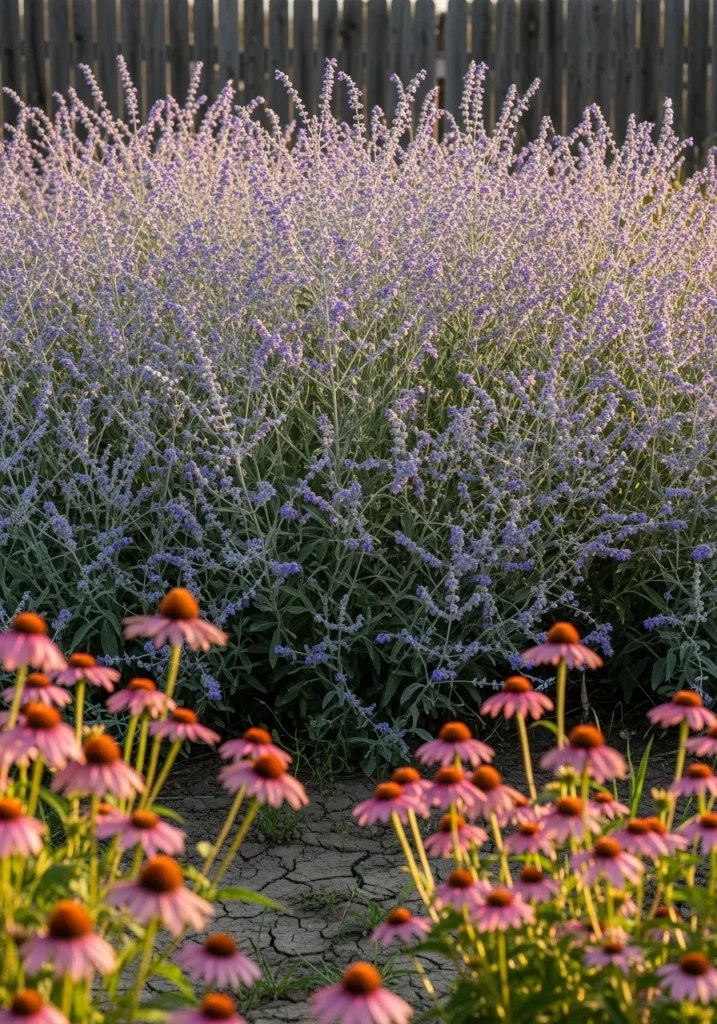
Russian Sage brings an airy, blue-purple haze of color to the fence line from midsummer through fall. Its silver stems and small lavender-blue flowers create a soft, wispy effect that contrasts beautifully with bolder plantings in front of it.
It thrives in hot, dry conditions and actually performs better with less water and fertilizer once established. The contrast between its fine texture and larger-leaved companions — hostas, ornamental grasses, coneflowers — looks genuinely sophisticated without any design expertise required.
Creative Fence Line Landscaping Ideas
13. Espaliered Fruit Trees

Espalier trains fruit trees flat against the fence in formal geometric or informal fan patterns, creating a living wall that produces actual fruit. Apple, pear, and fig trees all espalier beautifully against a sturdy fence.
It takes patience and annual pruning, but an espalied fence line is genuinely one of the most impressive things a home gardener can create. FYI, it requires a fence that receives at least 6 hours of direct sun daily — the trees need the light to produce fruit.
14. Raised Planting Beds Along the Fence

Narrow raised beds running along the fence line give you complete control over soil quality, drainage, and plant health. Even a bed 18–24 inches wide provides enough depth for most perennials, shrubs, and vegetables.
Raised beds also create a clean, defined edge between lawn and planting area that keeps the fence line looking tidy without constant edging maintenance. Build them from cedar, stone, or brick depending on your overall garden style.
15. Pollinator Garden Strip

A dedicated pollinator garden along the fence line — planted with native wildflowers, flowering herbs, and nectar-rich perennials — creates a wildlife habitat that buzzes and blooms from spring through fall. It requires almost no maintenance once established and genuinely improves your garden’s ecosystem.
Include milkweed for monarchs, native asters for late-season butterflies, wild bergamot for bees, and native grasses for overwintering insects. A pollinator strip along the fence rewards you with wildlife activity that makes the garden genuinely alive.
16. Hydrangea Hedge

A hydrangea hedge along the fence line delivers spectacular large blooms in white, pink, blue, and purple from midsummer through fall — and the dried flower heads look beautiful well into winter. Annabelle, Incrediball, Limelight, and PeeGee are all excellent fence line varieties.
Space plants 4–5 feet apart depending on variety. They fill in quickly and require minimal care beyond occasional pruning and adequate moisture. A hydrangea hedge transforms a plain fence into a genuine garden focal point.
17. Bamboo Screen Planting

Clumping bamboo planted along the fence line creates a lush, tropical privacy screen that grows quickly and looks striking in both traditional and contemporary gardens. Choose clumping varieties — Fargesia or Bambusa — rather than running types that spread uncontrollably.
Bamboo works particularly well against modern fences — its vertical lines and textural leaves complement clean, horizontal fence designs beautifully. It grows dense enough to block views between properties while adding a genuinely distinctive look.
18. Layered Cottage Garden Border

A layered cottage garden border along the fence combines tall shrubs or grasses at the back (against the fence), mid-height perennials in the middle, and low edging plants at the front. The result is a lush, abundant planting that looks complex but follows a simple three-layer principle.
Tall: Roses, hydrangeas, ornamental grasses. Middle: Coneflowers, salvias, daylilies, Russian sage. Front: Lavender, catmint, creeping thyme, or sedums. This three-layer approach creates depth, hides the fence entirely, and ensures something blooms at every level throughout the growing season.
Tips for Planning Your Fence Line Garden

Before you start planting, a few planning decisions make a real difference:
- Assess sunlight: Most of these plants need at least 6 hours of sun — a north-facing fence changes your plant choices significantly
- Check soil: Amend with compost before planting in a strip that may have compacted subsoil from fence post installation
- Plan for access: Leave a path or stepping stones behind the planting for fence maintenance without trampling plants
- Consider mature size: Plant at mature spacing from the start — crowded plants look great for one season and stressed for the next ten
- Edge properly: A clean edge between lawn and fence line planting keeps the whole thing looking intentional rather than accidental
FAQ
What grows well along a fence in the shade? Hostas, astilbe, ferns, hydrangeas (especially Annabelle), and climbing hydrangea all perform beautifully in partial to full shade fence line situations.
How do I stop weeds in my fence line garden? Apply a 3-inch layer of mulch after planting and refresh it each spring. Landscape fabric under the mulch helps in difficult areas, though it can complicate future planting.
What fence line plants require the least maintenance? Ornamental grasses, Knock Out roses, Black-Eyed Susans, daylilies, and native wildflowers all establish easily and require minimal ongoing care once planted.
How close to the fence should I plant? Plant most shrubs and perennials at least 18–24 inches from the fence base. Climbing plants obviously go right at the fence, but larger shrubs need space for airflow and root development.
Final Thoughts: Your Fence Deserves Better
A fence line that just marks a boundary is a wasted opportunity. Every one of these 18 ideas turns that boundary into a garden feature — something beautiful to look at from inside the house, to walk past, to sit near, and to enjoy throughout the seasons.
Start with one section. Pick the idea that excites you most — maybe climbing roses along the back fence, or a strip of ornamental grasses across the side — and plant it this season. Once you see how completely that one section transforms, you’ll be planning the rest of the fence line before the first frost. :/
Your backyard should be beautiful all the way to the edges. Go make it happen.